There are no products in your shopping cart.
| 0 Items | £0.00 |

Ayo Akinfe
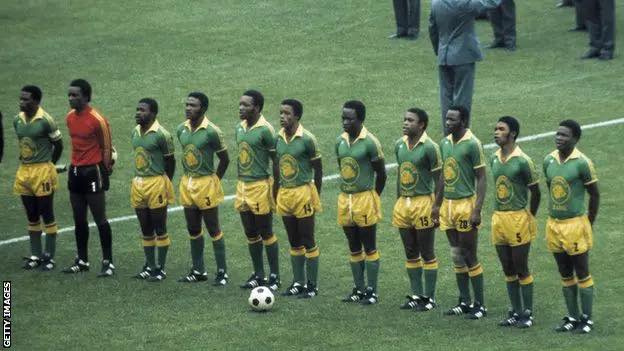
[1] Then called Zaire, the Congolese were the first sub-Saharan African team to qualify for the World Cup in 1974. Fifa gave Africa its first ever fully-fledged slot they year and Zaire clinched it by winning the 1974 Nations Cup, which held in Egypt, beating Zambia in the final
[2] At the 1974 World Cup in West Germany, Zaire lost her opening game to Scotland 0-2. They actually gave a good account of themselves in that match and left the pitch with their heads held high. Scotland’s team included David Harvey, Billy Bremner, Peter Lorimer, Kenny Dalglish, Joe Jordan, Denis Law, etc
[3] Their next game was against Yugoslavia and typical of African teams, bonus rows led to Zaire losing the match heavily. They lost 0-9 to Yugoslavia in a match that remains a huge embarrassment to Africa until today
[4] President Mobutu had set up a sizeable kitty for the players to dip into should they need or want to. He also sent over an enormous entourage of government and Zairean football federation officials to bolster the ranks and as something of a sign of strength. However, officials bled the funds completely dry and the players soon discovered this. They realised that the money was not just for allowances, it was for their wages and bonuses and they had been ripped off. Understandably, there was outrage and mutiny in the camp. A good majority of the squad declared that they would not play on June 18. Fifa stepped in and allegedly paid some 3,000 Deutsche Marks per player to take to the field and save the tournament's reputation. Reluctantly, the players trudged out onto the pitch of the Parkstadion in Gelsenkirchen but while they were there in body, they were not there in spirit. The game quickly turned into a farce. It could be argued that Zaire threw the game in protest.
[5] In one of the oddest openings to any international match ever, Yugoslavia took a three-goal lead in 20 minutes. So Zaire coach Blagoje Vidinić - a former Yugoslav international himself - decided to substitute his goalkeeper. Off came Kazadi Muamba in the 21st minute. On came Dimbi Tubilandu who was just 5'4" on tiptoes. Within a minute he had conceded himself. He would have to pick the ball out of his net a further five times that evening.
[6] After the game, Mobutu sent his presidential guards to threaten the players in their team hotel. Fullback Mwepu Ilunga has since claimed in an interview given to the BBC that the guards closed the hotel to all journalists and said that if they lost 0-4 to Brazil in their final group match, none of the players would be able to return home. They ended up only losing 0-3 to Brazil
[7] After the tournament, the Yugoslav coach
Blagoje Vidinić did not return to Zaire but went straight back to his home country. Upon returning home, the players, rather than being received with a luxurious coach as had been the case after their Nations Cup triumph, had an empty army truck waiting for them. They were driven straight to the presidential palace, where President Mobutu was waiting for them.
[8] Of the meeting, the team captain said: “There he gave us an ear full. He looked at us over the rim of his glasses, like an angry dad to his children: "So you thought you would rebel? I gave you all a house and a car!". He was furious. Not one player dared to speak. It was deathly quiet. In the end I softly asked to have the word and I apologised for what happened. It's the only thing I could have done. He finished with "Next time I'll throw you all in jail."
[9] As punishment, none of the players could leave the country. A list in the port and the airport of their names was displayed with "Forbidden to leave the country". This scuppered the players prospects of moves to European clubs with the offers that came in after the World Cup
[10] After the World Cup, Mobutu lost interest in football and stopped actively using the Zaire national team as a political tool for promoting his regime. One of the players ended up being homeless. In 2012 a charity raised money for the surviving players to receive a small pension every month of a couple of hundred dollars.
